First solve
Finite-substrate microbial growth: maximize cumulative growth while a resource pool is exhausted. The horizon \(T\) is free. The script below is complete. Formulation, closed loop, and further figures: Microbial growth.
If IPOPT fails, see Troubleshooting. For what
counts as a state, a control, or a cost, see
Posing a problem.
The control is piecewise constant on the collocation mesh; see
Transcription.
Time bounds are written explicitly in st
(Constraints and time).
This right-hand side uses only +, -, *, /, so there is no
import casadi. Named signals are a Namespace
(CasADi expressions). A list of derivatives
is stacked by System; a one-state model may return a scalar.
import eco_opt
from eco_opt import Namespace

BETA, GAMMA, R, EMAX, MU, K = 0.5, 0.5, 0.1, 0.5, 0.5, 0.0


def growth_rate(u):
    return EMAX * BETA * (u - R) / (u + BETA) - K * u


def microbial_growth_model(t, x, u):
    Cs, uptake = x[0], u[0]
    G = growth_rate(uptake)
    dx = -uptake - GAMMA * Cs + MU * G
    y = Namespace(Cs=Cs, uptake=uptake, growth=G)
    return dx, y


sys = eco_opt.System(states=1, controls=1, model=microbial_growth_model)
ocp = eco_opt.Ocp()
ocp.max([growth_rate(sys.y.uptake)])
ocp.st(
    system=sys,
    constraints=[
        (0, "==", eco_opt.t_0(sys.t)),
        (1, "==", eco_opt.t_0(sys.y.Cs)),
        (0, "<=", eco_opt.t_f(sys.t), "<=", float("inf")),
        (0, "<=", sys.y.Cs, "<=", 1),
        (0, "<=", sys.y.uptake, "<=", 10),
    ],
)
sol = ocp.solve(
    control_intervals=200,
    polynomial_degree=5,
    collocation_points="radau",
    tf_guess=2.0,
)
print(sol.success, sol.tf, sol.objective)
Same solve as a module: examples/microbial_growth/microbial_growth.py.
That command writes the comparison figure and prints its path:
cd examples/microbial_growth
python microbial_growth.py
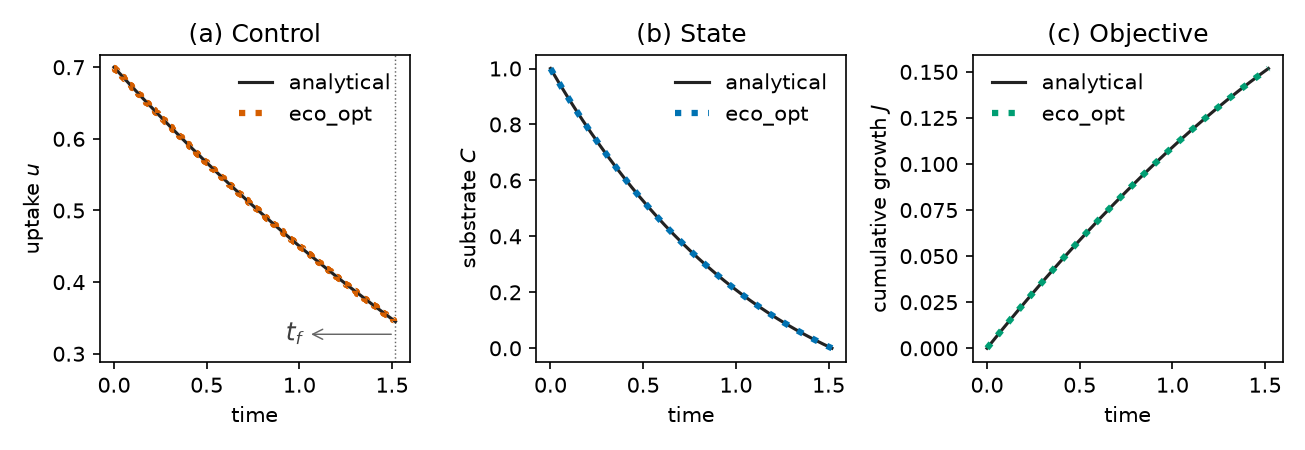
sol.success should be true. This mesh gives \(T\approx 1.518\) and
\(J\approx 0.1518\). How to read sol and plot with matplotlib:
Results and plots.
The figure compares collocation (thick dotted) to an independent analytical solution (solid): control, substrate, and cumulative growth, with \(t_f\) marked on the control panel.