Goddard, dimensional (goddard_benchmark)
Question. What thrust history maximizes final altitude of a vertical rocket when burnout time is free?
This is a transcription check, not an ecological model. First solve is microbial growth.
Formulation
| Symbol | Role | Meaning |
|---|---|---|
| \(v,h,m\) | states | velocity, altitude, mass |
| \(F\) | control | fuel mass-flow |
Dynamics.
with exponential drag and inverse-square gravity (SI constants as in the archived Yop run).
Objective. \(\max h(T)\). Horizon. Free.
Constraints. \(v(0)=h(0)=0\), \(m(0)=214.839\), \(m(T)\ge 67.9833\), \(0\le F\le 9.525515\).
What was done
Declared the same way as the ecological examples. Compared to
work/goddard_benchmark/yop_goddard.mat (59 intervals, degree 5,
Legendre).
What we found
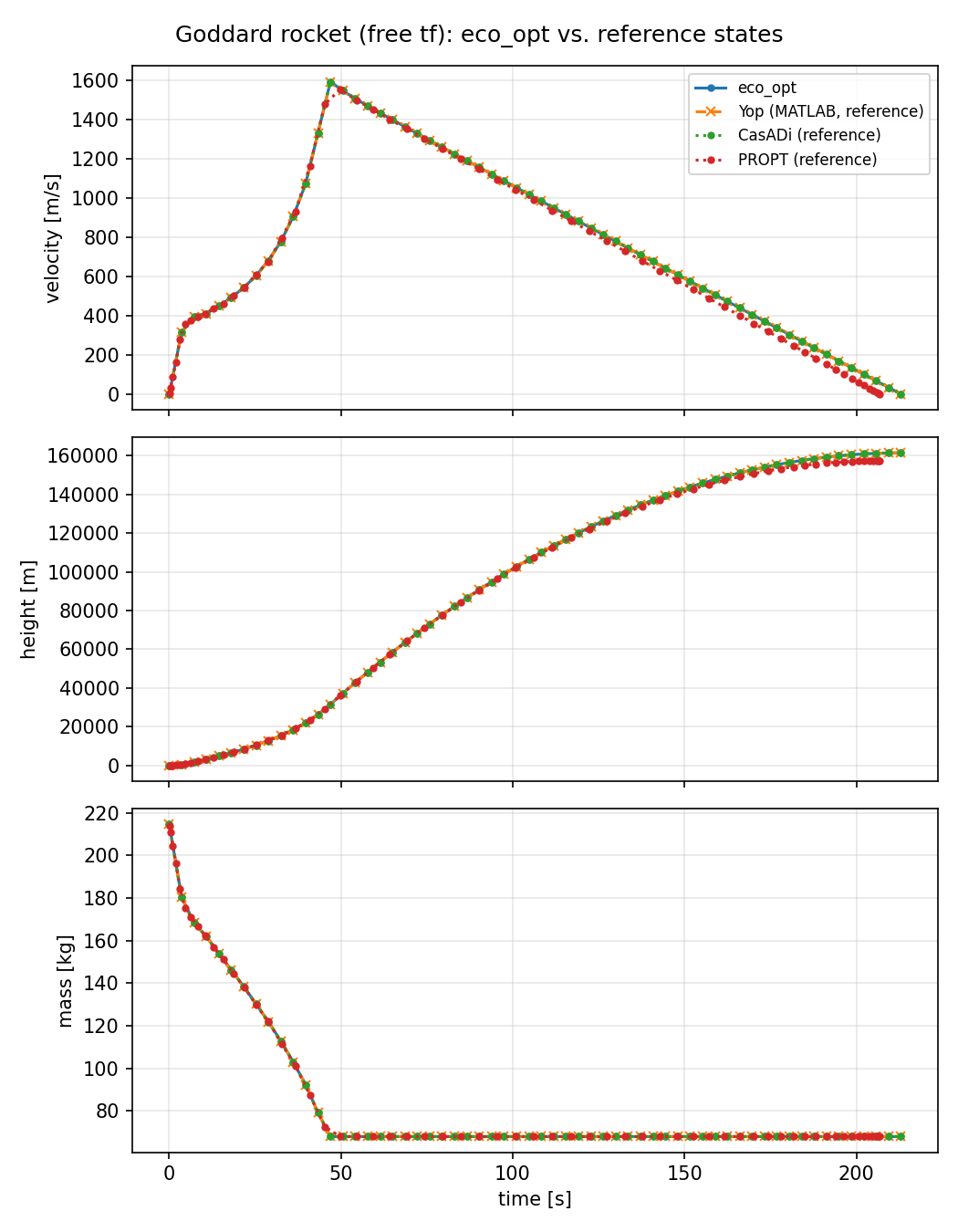
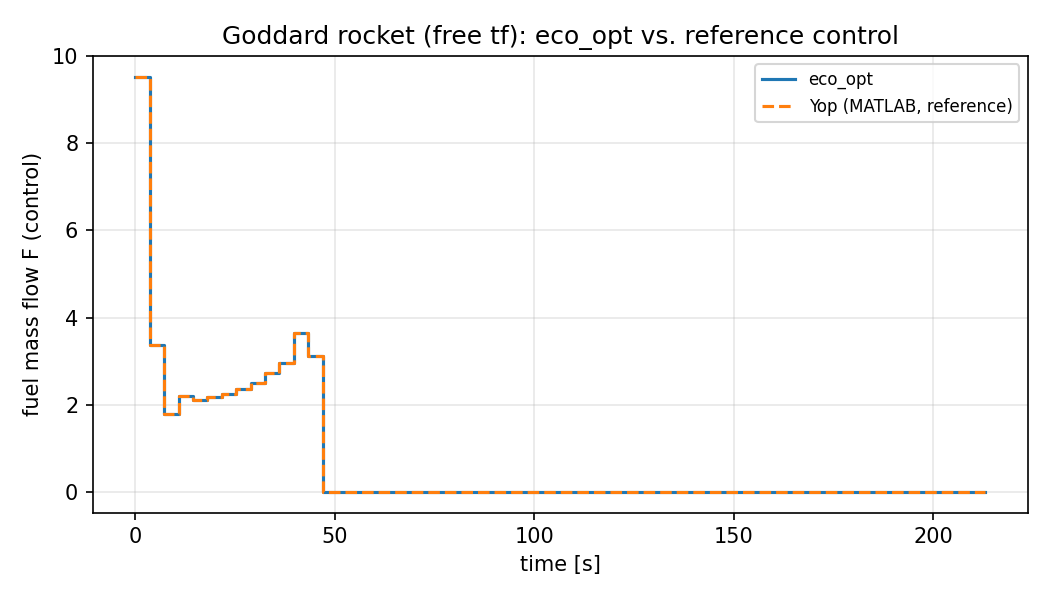
Altitude and \(T\) agree with the archive to relative errors on the order of \(10^{-14}\). Control shows bang–singular–coast.
Interpretation
Before ecological trajectories are trusted, free time, bounds, and collocation are checked on a problem with an independent reference. Agreement here is about the transcriber, not about rockets in ecology. This is not First solve.
Public API
Full script: examples/goddard_benchmark/goddard_benchmark.py.
import casadi as cs is for exp/sign in \(f\), not for
Namespace. First hour of the package is
First solve (microbial growth).
import casadi as cs
import eco_opt
from eco_opt import Namespace


def goddard_model(t, x, u):
    v, h, m, F = x[0], x[1], x[2], u[0]
    ...
    y = Namespace()
    y.rocket = Namespace(velocity=v, height=h, mass=m, fuelMassFlow=F)
    return [dv, dh, dm], y


sys = eco_opt.System(states=3, controls=1, model=goddard_model)
ocp = eco_opt.Ocp()
ocp.max(eco_opt.t_f(sys.y.rocket.height))
ocp.st(system=sys, constraints=[...])
sol = ocp.solve(control_intervals=59, polynomial_degree=5, tf_guess=200.0)
Run and tests
cd examples/goddard_benchmark
python goddard_benchmark.py
python plot_goddard_benchmark.py
python -m pytest ../../tests/test_goddard_benchmark.py -q
References
Classic Goddard problem. Yop pages: free \(t_f\), overview. The text and code here are ours.