Bang-bang free horizon (bang_free_tf)
Question. How fast can a double integrator move from rest to a distant rest when the horizon is free and thrust bounds are asymmetric?
Formulation
| Symbol | Role | Meaning |
|---|---|---|
| \(x,v\) | states | position, velocity |
| \(u\) | control | acceleration |
Dynamics. \(\dot x=v\), \(\dot v=u\).
Objective. \(\min T\).
Constraints. \(-2\le u\le 1\), \((x,v)(0)=(0,0)\), \((x,v)(T)=(300,0)\), \(T\ge 0\).
Horizon. Free.
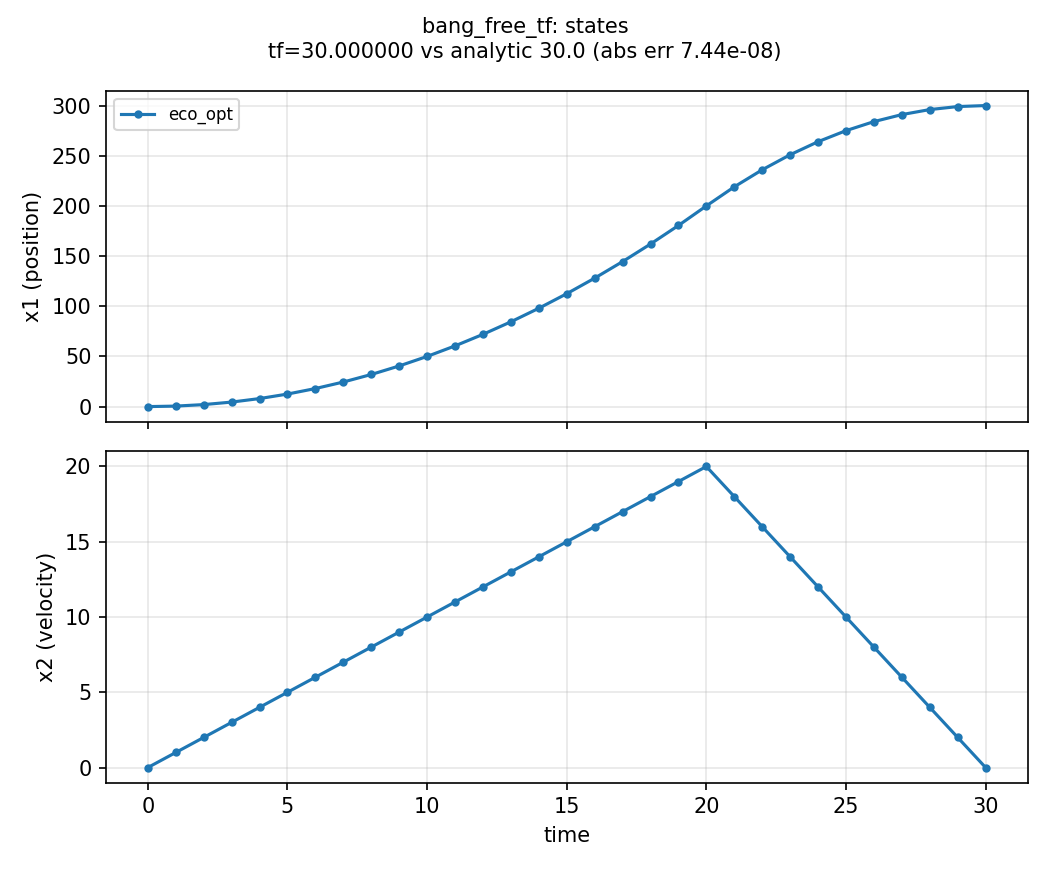
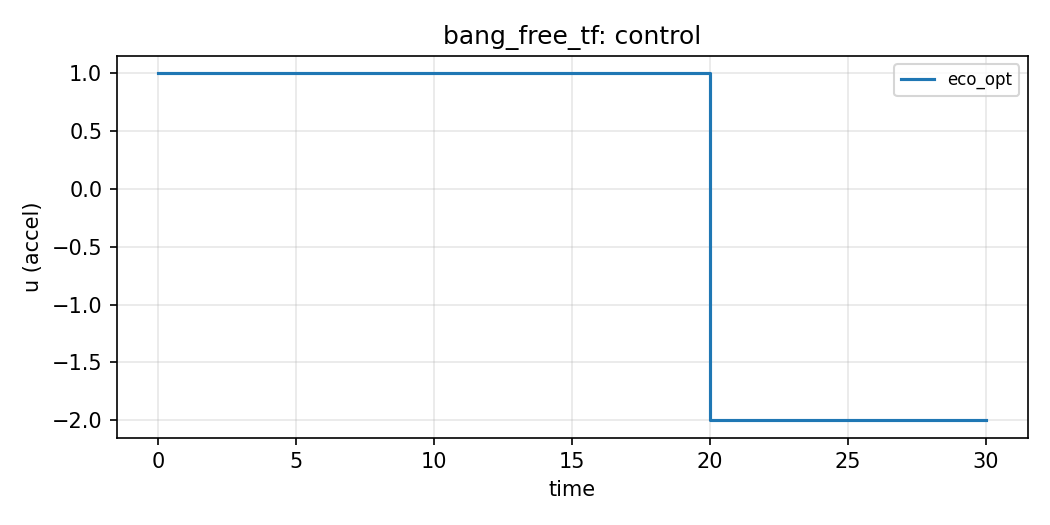
Analytic: \(u=+1\) on \([0,20]\), \(u=-2\) on \([20,30]\), \(T^*=30\).
What was done
ocp.min(t_f(t)) with a free upper bound on \(T\). Legendre
collocation.
What we found
Numerical \(T\) agrees with \(30\) to about 1%. States meet the terminal rest condition.
Interpretation
Unequal bounds on \(u\) shift the switch away from the midpoint. The horizon is a decision: the problem is finished when the target is reached, not at a prescribed clock time.
Public API
Bare dx, no Namespace (examples/bang_free_tf/bang_free_tf.py):
import eco_opt


def bang_model(t, x, u):
    return [x[1], u[0]]


sys = eco_opt.System(states=2, controls=1, model=bang_model)
ocp = eco_opt.Ocp()
ocp.min(eco_opt.t_f(sys.t))
ocp.st(system=sys, constraints=[...])
Run and tests
cd examples/bang_free_tf
python bang_free_tf.py
python plot_bang_free_tf.py
python -m pytest ../../tests/test_bang_free_tf.py -q
References
Transcription of the Yop example Linear problem with bang-bang control. The problem is the same; the text and code here are ours.