Nondifferentiable pulse (non_diff)
Question. Can collocation handle a rectangular pulse in \(f\)
written with if_else?
This is a numerical pulse, not phenology or ecological regime
switching. The pulse is written with CasADi if_else because a
Python if cannot branch on symbolic time; see
Transcription.
Formulation
Dynamics.
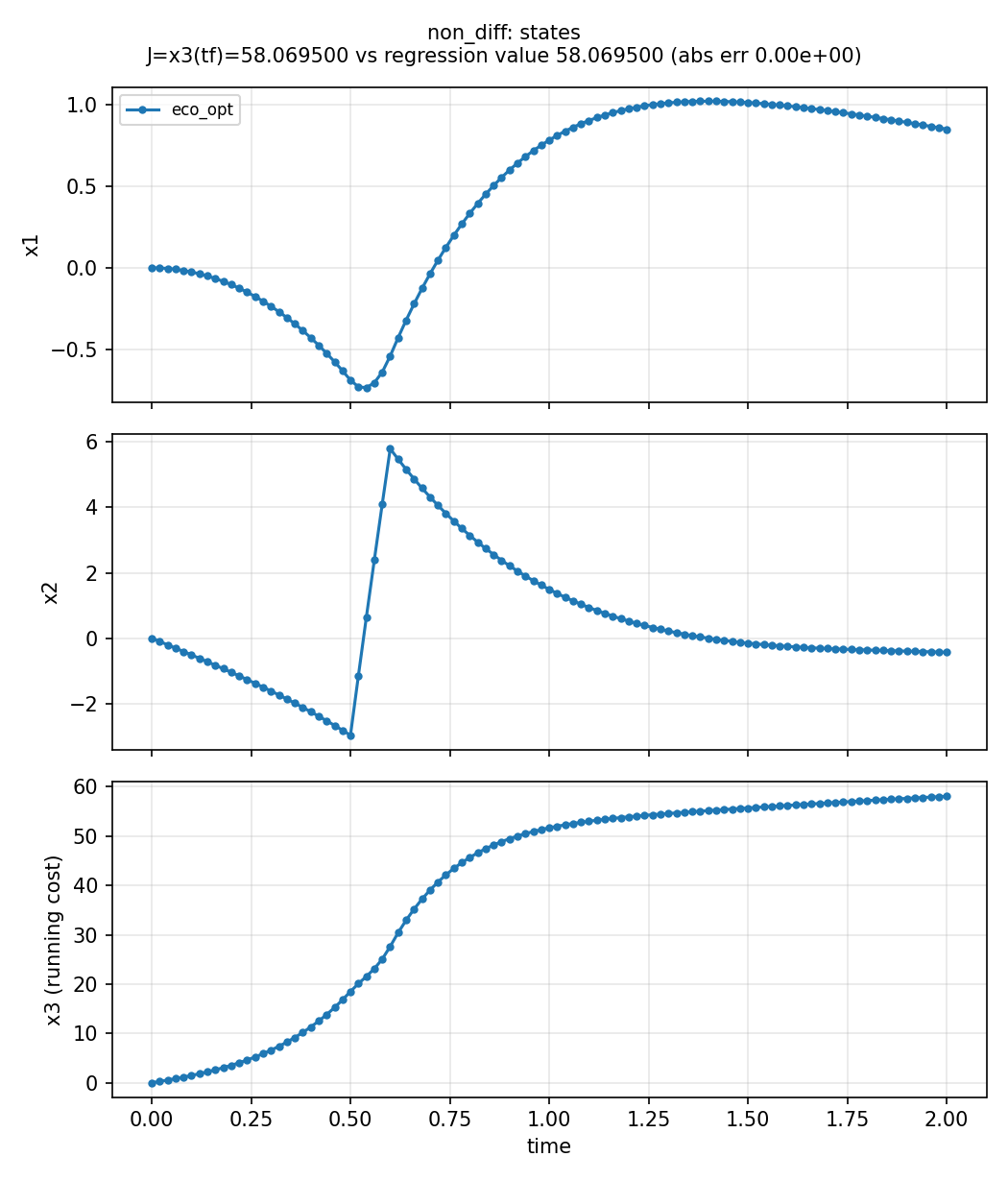
with \(d(t)\) a pulse of height 100 on \([0.5,0.6]\) via nested
if_else.
Objective. \(\min x_3(T)\). Horizon. Fixed, \(T=2\). \(\mathbf{x}(0)=\mathbf{0}\).
What was done
Radau, degree 3, 100 intervals; control guess \(-5\).
What we found
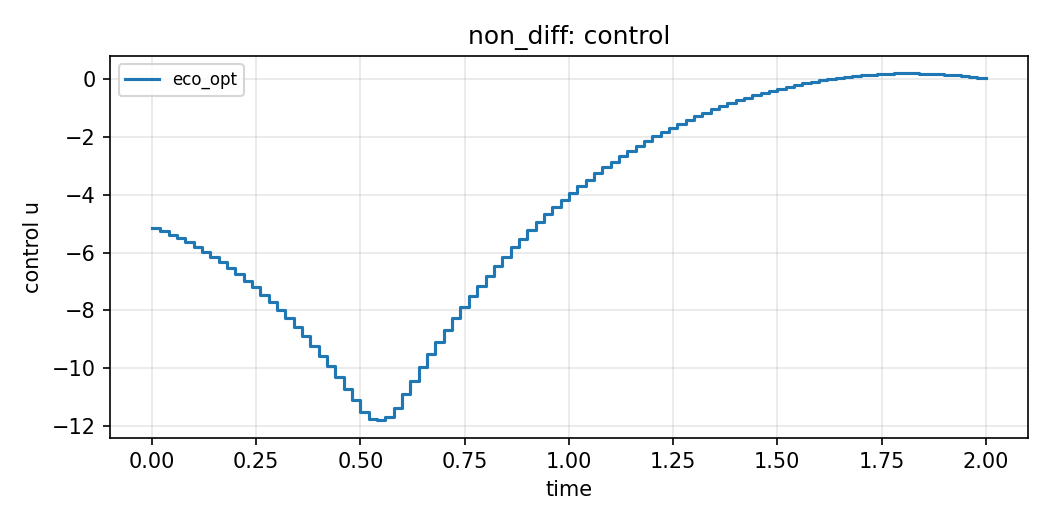
Solver succeeds. Regression \(J^*\approx 58.07\). The pulse is visible in \(x_2\).
Interpretation
A jump in forcing is not a jump in the control. Bang–bang allocation (Cohen, Lindh) is a different object. Do not read this example as a phenology switch.
Public API
Bare dx (examples/non_diff/non_diff.py):
import eco_opt


def nondiff_model(t, x, u):
    ...
    return dx


sys = eco_opt.System(states=3, controls=1, model=nondiff_model)
ocp = eco_opt.Ocp()
ocp.min(eco_opt.t_f(sys.x[2]))
ocp.st(system=sys, constraints=[...])
Run and tests
cd examples/non_diff
python non_diff.py
python plot_non_diff.py
python -m pytest ../../tests/test_non_diff.py -q
References
Yop example Nondifferentiable system. The text and code here are ours.