Cohen and King allocation (cohen_king_roughgarden)
Question. For an annual plant (one vegetative compartment, one reproductive compartment), how should allocation switch through a fixed season?
Here plant means that annual-plant model.
Formulation
| Symbol | Role | Meaning |
|---|---|---|
| \(x_1(t)\) | state | vegetative biomass |
| \(x_2(t)\) | state | reproductive biomass |
| \(u(t)\in[0,1]\) | control | fraction of production kept vegetative |
Dynamics (relative growth rate 1 in these units).
Objectives (same \(f\), two hypotheses).
Constraints. \(x_1(0)=X_{10}>0\), \(x_2(0)=0\), \(0\le u\le 1\). Horizon. Fixed season \(T\).
What was done
One collocation grid; \(u(t)\) free in \([0,1]\). Cohen uses a Mayer term \(t_f(x_2)\); King uses a running log payoff.
What we found
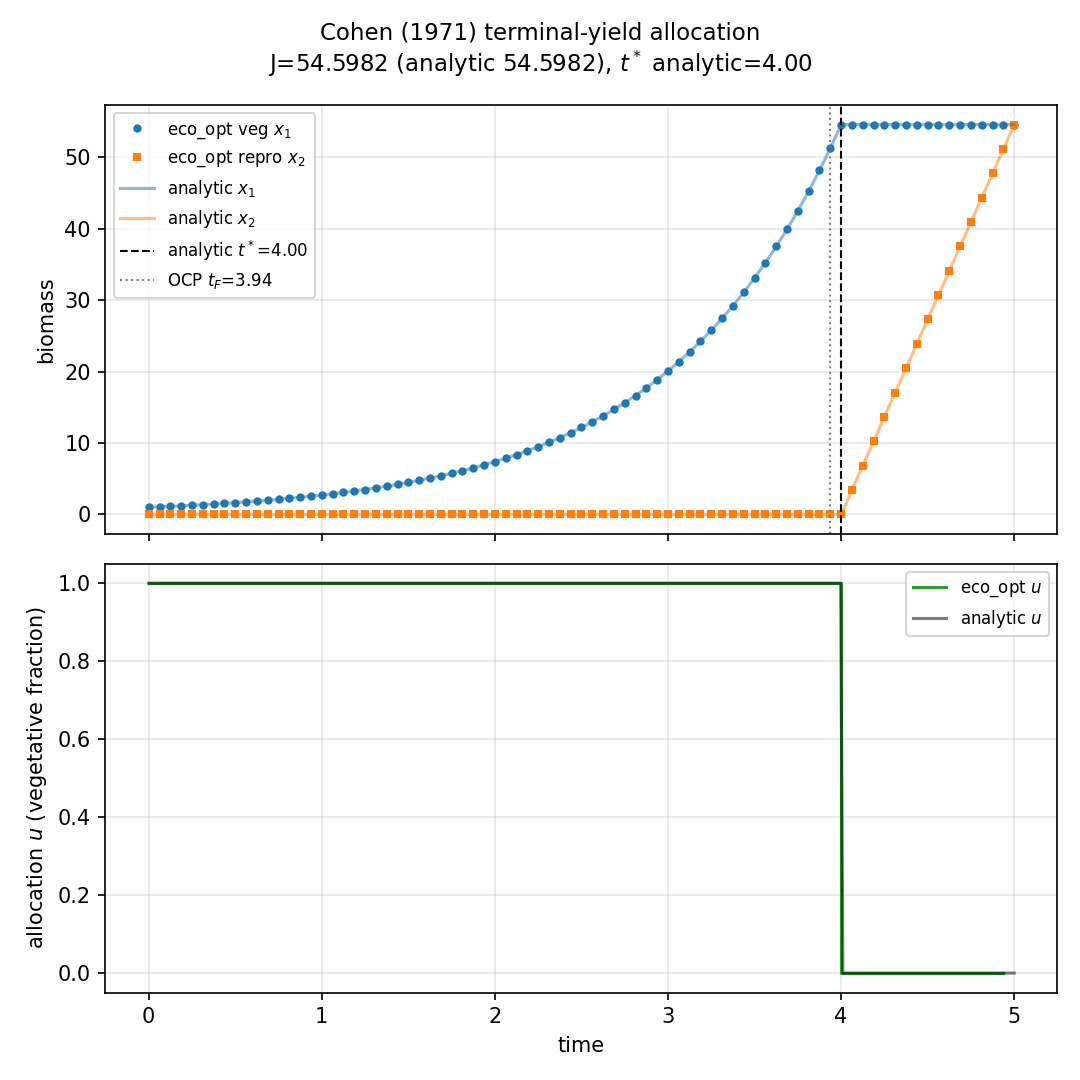
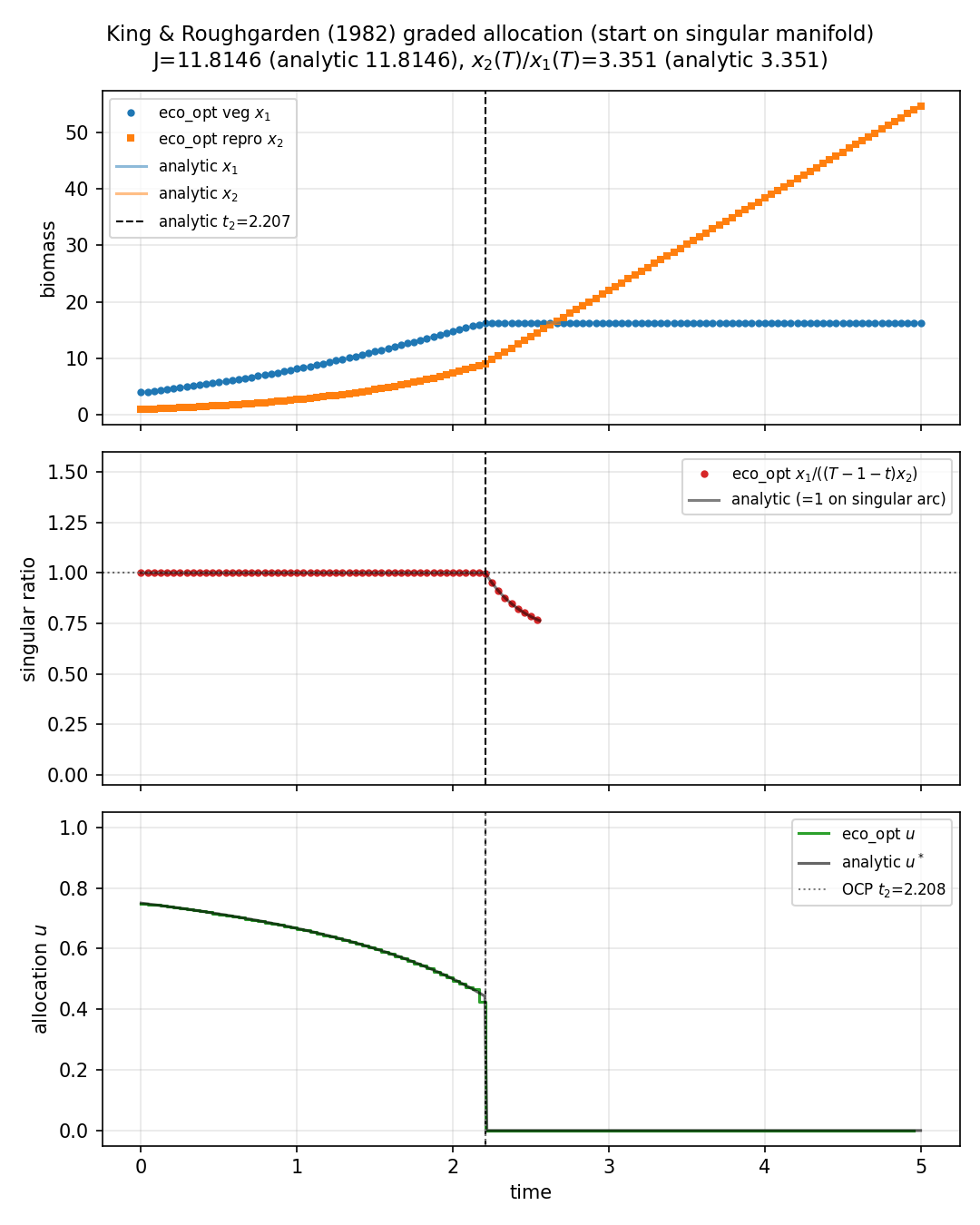
Cohen is bang–bang: \(u^*=1\) on \([0,T-1]\), then \(u^*=0\). For defaults \(T=5\), \(X_{10}=1\), switch at \(4\) and \(x_2(T)=e^{4}\). King is bang–singular–bang: a mixed-growth arc with \(x_1=(T-1-t)x_2\). The OCP recovers both closed forms.
Interpretation
The same plant ODE yields different schedules when \(J\) changes: a single terminal harvest (Cohen) versus a running reproductive payoff (King). The switch is not inserted in \(f\); it is implied by \(J\) and \(0\le u\le 1\).
Public API
Cohen terminal yield (examples/cohen_king_roughgarden/cohen_terminal_yield.py):
import eco_opt
from eco_opt import Namespace


def plant_model(t, x, u):
    veg, repro, alloc = x[0], x[1], u[0]
    y = Namespace(veg=veg, repro=repro, alloc=alloc)
    return [alloc * veg, (1.0 - alloc) * veg], y


sys = eco_opt.System(states=2, controls=1, model=plant_model)
ocp = eco_opt.Ocp()
ocp.max(eco_opt.t_f(sys.y.repro))
ocp.st(system=sys, constraints=[...])
Run and tests
cd examples/cohen_king_roughgarden
python cohen_terminal_yield.py
python king_singular_allocation.py
python plot_cohen_king.py
python -m pytest ../../tests/test_cohen_king_roughgarden.py -q
References
Cohen (1971), maximizing terminal seed yield. King and Roughgarden (1982), graded allocation with a log running payoff.
Not validated against published figures
Numerics are checked against the papers’ closed-form controls and yields, not against figures from those papers.