Irrigation bucket (irrigation_bucket)
Question. How does an irrigation schedule designed for a dry forecast compare with a closed loop that sees rain on the water store?
Formulation
| Symbol | Role | Meaning |
|---|---|---|
| \(S(t)\) | state | root-zone storage (mm) |
| \(u(t)\) | control | irrigation (mm d\(^{-1}\)) |
| \(P(t)\) | forcing | rain (forecast vs realised) |
| \(E(t)\) | forcing | evapotranspiration |
Dynamics.
Objective. \(\min \int_0^T u\,\mathrm{d}t\).
Constraints. \(S_{\min}\le S\le S_{\max}\). Horizon. Fixed.
The OCP forecast uses \(P\equiv 0\). Closed loop can apply rain to the
simulated water store while the controller still plans dry.
(plant= in the API means that simulated process, not vegetation.)
What was done
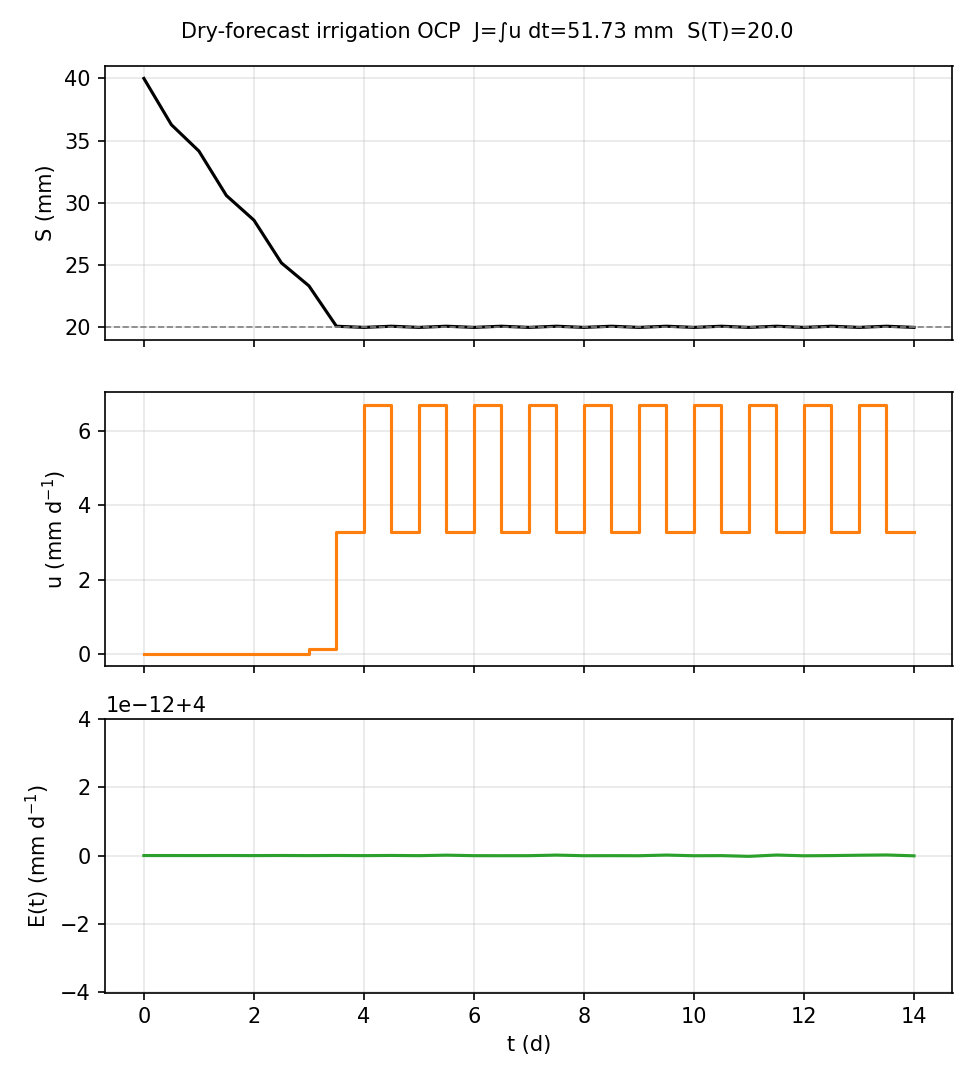
The OCP is always the dry forecast: \(P\equiv 0\), sinusoidal ET, minimize irrigation, keep \(S\) between field-capacity-style bounds. That tape is the grower’s plan written on day 0.
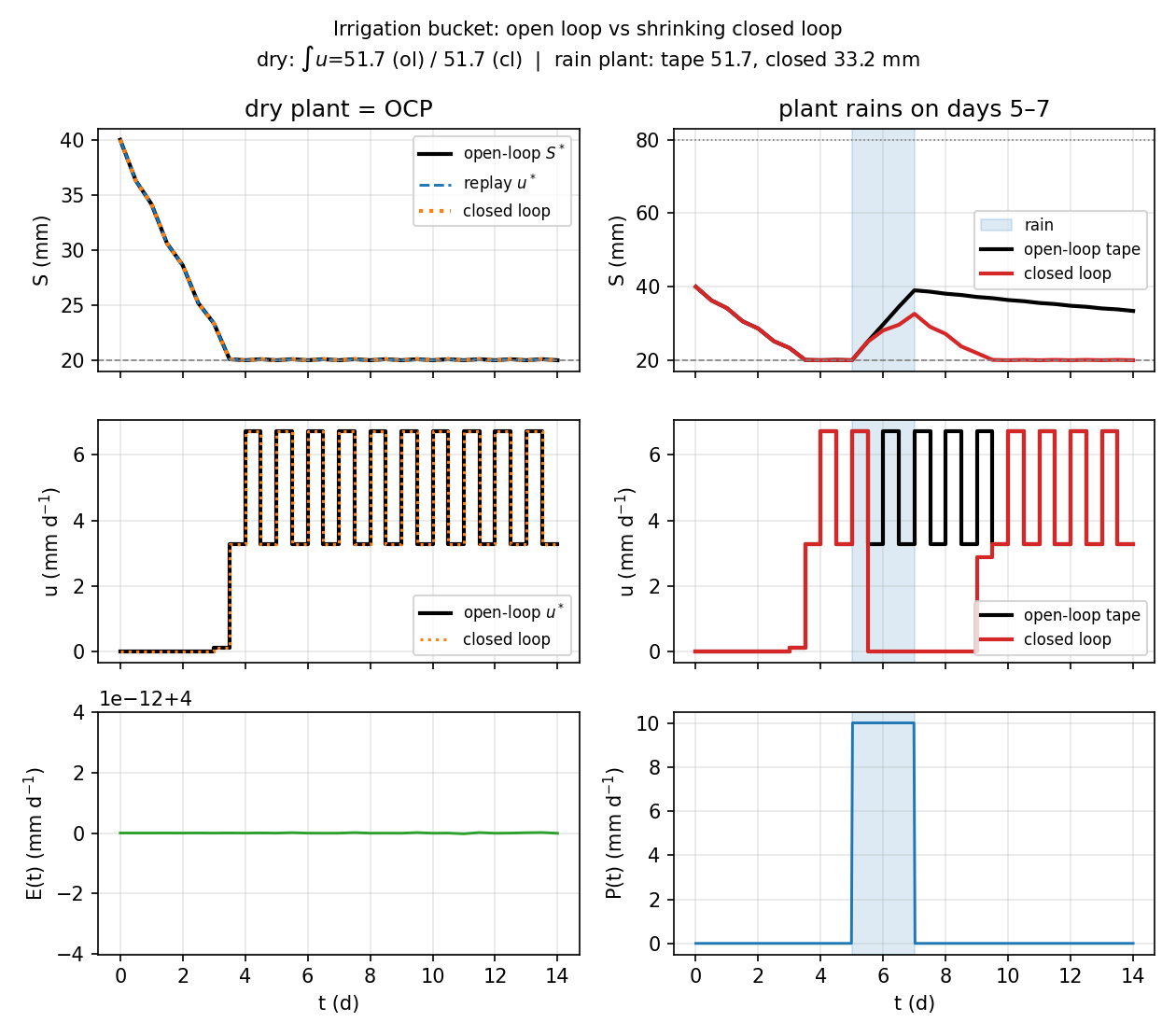
Four integrations:
- Open-loop NLP on the dry model (\(J^*\approx 51.7\,\mathrm{mm}\)).
simulateof that \(u^*\) on the same dry model — must reprint \(S^*(t)\).- Shrinking
closed_loopon the dry model — must reprint \(u^*\) (nothing unexpected happens). - Unforecast rain on the water store in days 5–7: replay the dry tape vs re-solve from measured \(S\).
Rain is applied to storage \(S\), not to a vegetation canopy. The API
keyword plant= is the simulated process model (control-theory name).
What we found
On the dry process, closed-loop \(u\) matches the open-loop tape (max \(|u-u^*|\) small). After rain, the tape keeps irrigating as if the soil were still dry and can pile \(S\) toward \(S_{\max}\). The closed loop sees the wetter store and cuts irrigation (more than \(5\,\mathrm{mm}\) less water in the test). Storage stays in bounds in both cases; the difference is wasted pumping, not a bound violation.
Interpretation
Open loop answers: given this forecast, what irrigation is optimal? Closed loop answers: given the store I measure now, what irrigation is optimal for the remaining season? Those coincide only if the forecast was right. In ecology that is the difference between a seasonal allocation plan and re-allocation after a rain, a litterfall pulse, or a missed mineral-N flush. The OCP does not become a different hypothesis; the state from which it is solved changes.
Public API
Full script: examples/irrigation_bucket/irrigation_bucket.py.
import eco_opt
from eco_opt import Namespace


def dry_model(t, x, u):
    S, irr = x[0], u[0]
    dS = irr - et(t) - K_DRAIN * S
    y = Namespace(S=S, u=irr)
    return dS, y


sys = eco_opt.System(states=1, controls=1, model=dry_model)
ocp = eco_opt.Ocp()
ocp.min([sys.y.u])
ocp.st(system=sys, constraints=[...])
sol = ocp.solve()
Closed loop on a rainy process: ocp.closed_loop in
examples/irrigation_bucket/open_vs_closed.py.
Run and tests
cd examples/irrigation_bucket
python irrigation_bucket.py
python plot_irrigation_bucket.py
python open_vs_closed.py
python -m pytest ../../tests/test_irrigation_bucket.py -q
References
Inspired by Shang, Chen, Stroock and You (2020). Not a
reproduction of their robust forecasts or water-saving number. The
eco_opt trajectories are not validated against that paper’s
figures.