Goddard landing (multiphase_goddard_landing)
Question. After maximizing altitude, can a second phase land the same rocket (\(h=v=0\)) with a free switch and free total time?
Transcription check, not ecology.
Formulation
Phase 1. Same Goddard ascent ODE; maximize altitude; free switch.
Phase 2. Same ODE; reach \(h=0\), \(v=0\); free \(T\).
Continuity of time and of \((v,h,m)\) at the junction. Thrust bounds as in the dimensional vehicle.
What was done
Two Phase objects, continuity=True, Radau. Same rocket as
goddard_benchmark.
What we found
A peak altitude near \(8.21\times 10^4\,\mathrm{m}\) then a landing phase; total \(T\approx 289\,\mathrm{s}\) (regression).
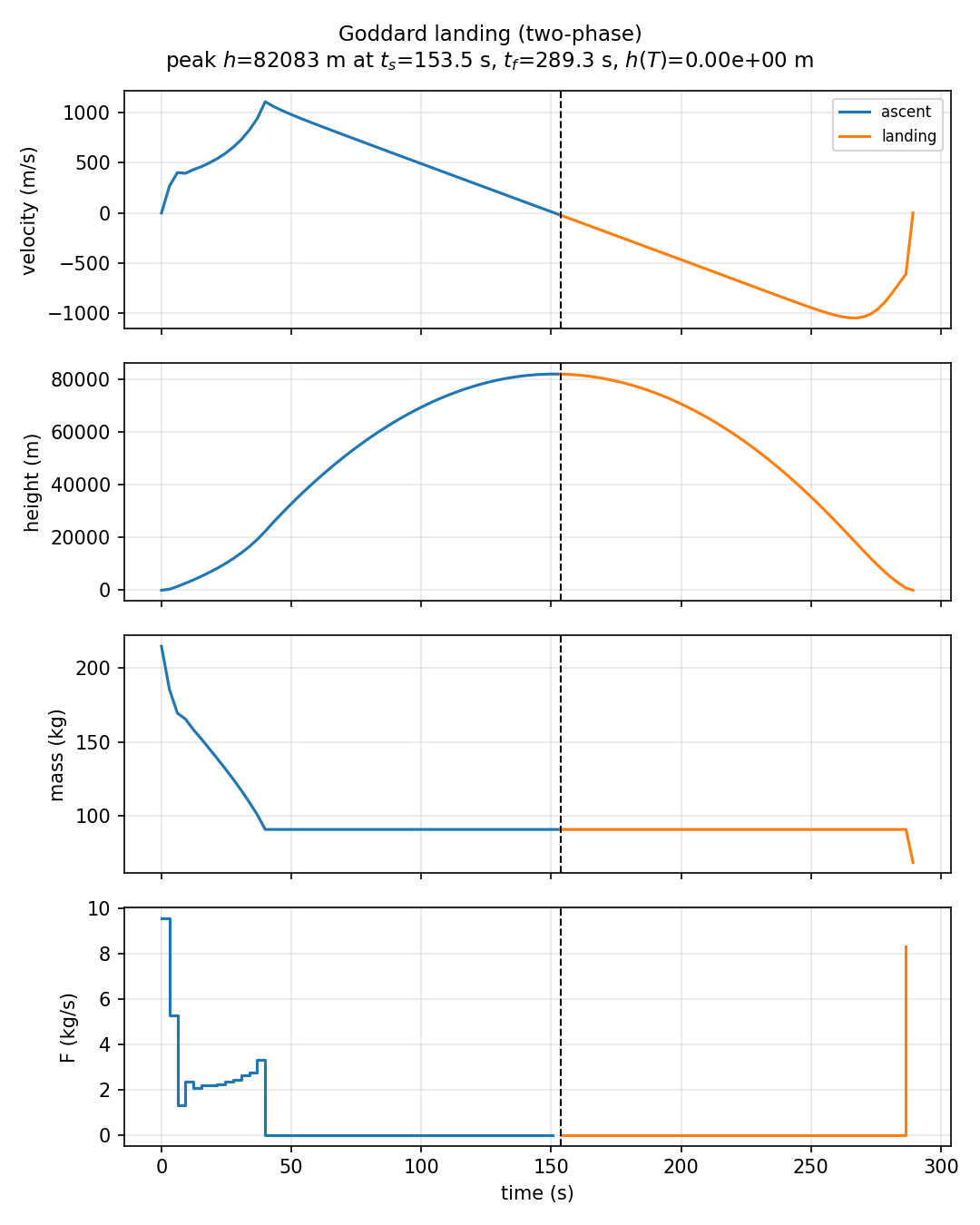
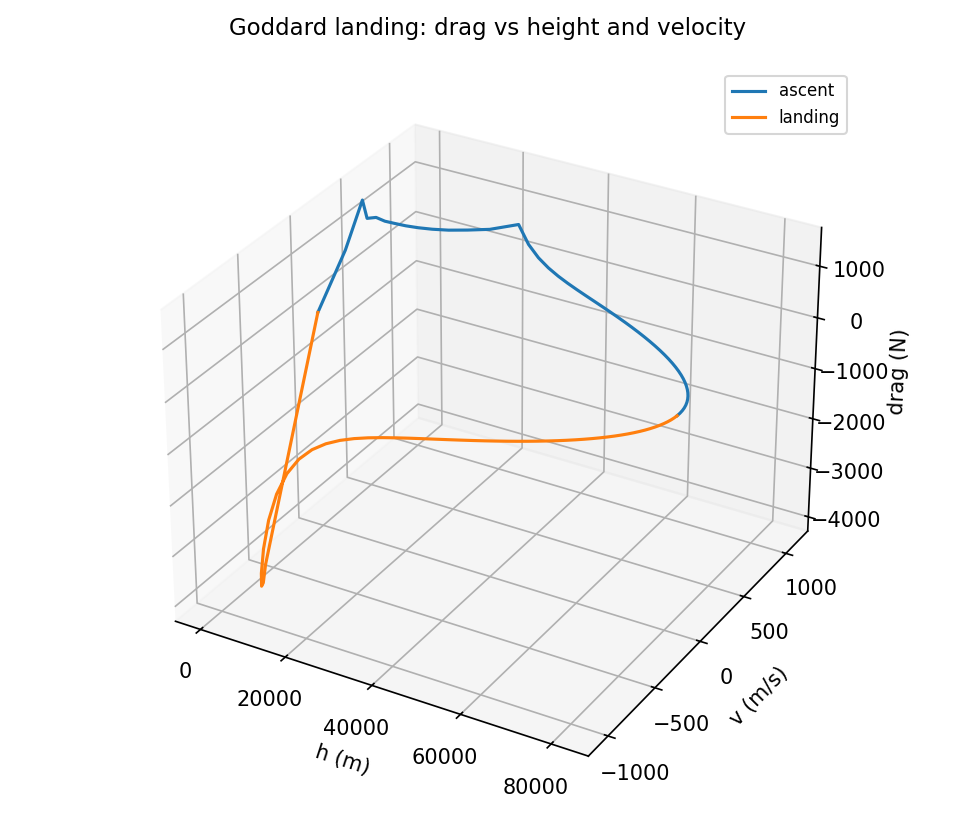
Interpretation
Multi-phase collocation is for sequential missions (or sequential life-history stages in ecology). The landing bound is a terminal condition on phase 2, not a path constraint on the whole horizon.
Public API
Full script: examples/multiphase_goddard_landing/goddard_landing.py.
import eco_opt
from eco_opt import Namespace, Phase

sys1 = eco_opt.System(states=3, controls=1, model=goddard_model, name="ascent")
sys2 = eco_opt.System(states=3, controls=1, model=goddard_model, name="landing")
p1 = Phase(sys1, constraints=[...], name="ascent")
p2 = Phase(sys2, constraints=[...], name="landing")
ocp = eco_opt.Ocp()
ocp.max(eco_opt.t_f(sys1.y.rocket.height))
ocp.st(phases=[p1, p2], continuity=True)
Run and tests
cd examples/multiphase_goddard_landing
python goddard_landing.py
python plot_goddard_landing.py
python -m pytest ../../tests/test_multiphase_goddard_landing.py -q
References
Yop example Goddard rocket landing. The text and code here are ours.