Isoperimetric constraint (iso_constraint)
Question. How is a fixed integral of the control (a budget) enforced?
Formulation
Dynamics.
Objective. \(\min\int_0^1 x_1\,\mathrm{d}t\).
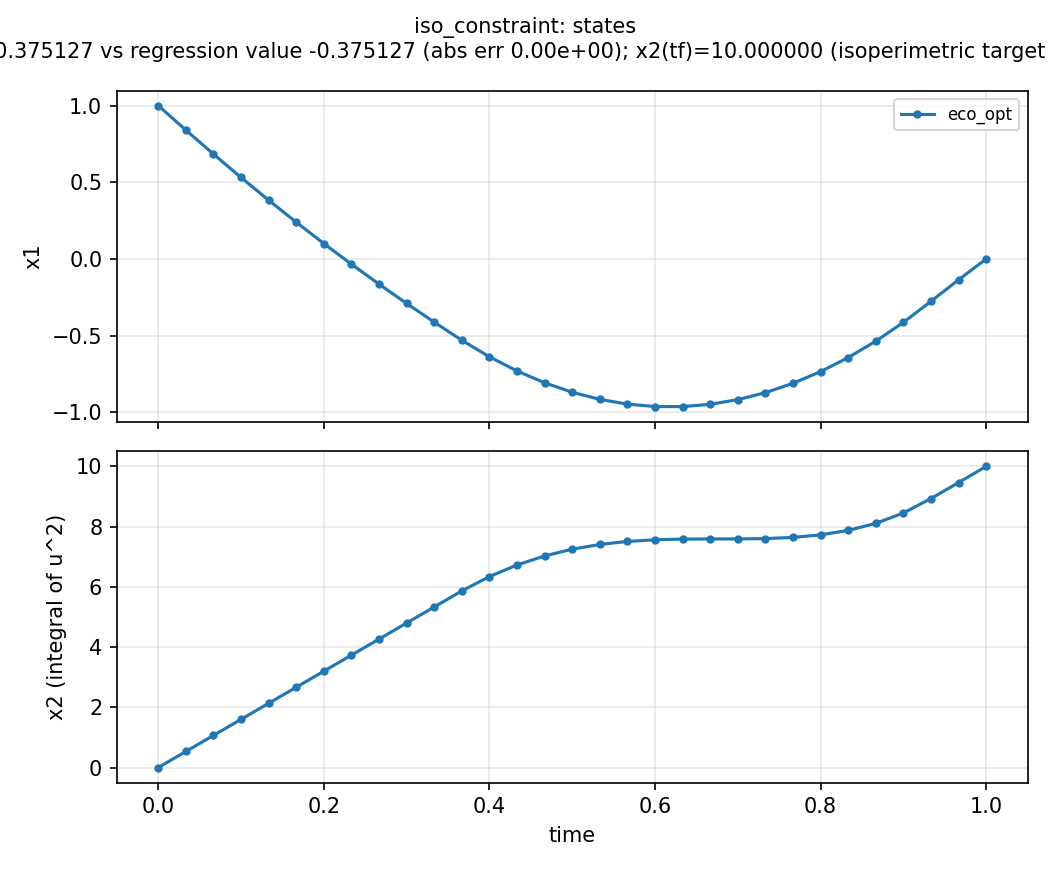
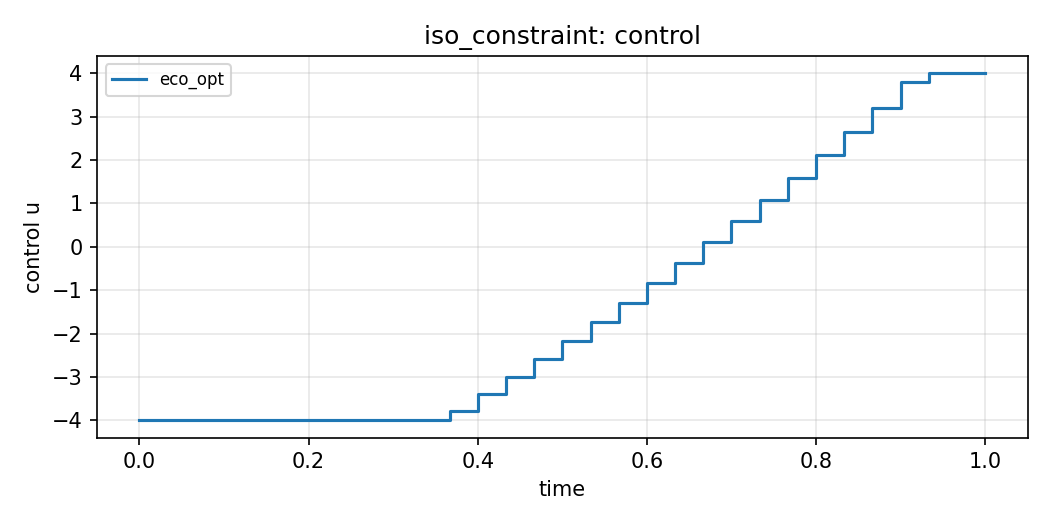
Constraints. \(x_1(0)=1\), \(x_2(0)=0\), \(x_1(1)=0\), \(x_2(1)=10\), \(-4\le u\le 4\). The condition \(x_2(1)=10\) is \(\int_0^1 u^2\,\mathrm{d}t=10\) (an isoperimetric budget as an auxiliary state; see Constraints and time).
Horizon. Fixed, \(T=1\).
What was done
An auxiliary integral state carries the budget. No Namespace tree
(bare dx).
What we found
\(x_2(T)=10\) is met. Regression \(J^*\approx -0.375\).
Interpretation
A cumulative C, N, water, or management budget is the same object: an integral constraint, implemented as a terminal value of an extra state. It is not a path bound on \(u(t)\) at each instant.
Public API
No Namespace: the model returns bare dx (examples/iso_constraint/iso_constraint.py).
import casadi as cs
import eco_opt


def iso_model(t, x, u):
    return [-cs.sin(x[0]) + u[0], u[0] ** 2]


sys = eco_opt.System(states=2, controls=1, model=iso_model)
ocp = eco_opt.Ocp()
ocp.min([sys.x[0]])
ocp.st(system=sys, constraints=[...])
Run and tests
cd examples/iso_constraint
python iso_constraint.py
python plot_iso_constraint.py
python -m pytest ../../tests/test_iso_constraint.py -q
References
Yop example Isoperimetric constraint problem. The text and code here are ours. No published numerical target for this instance.